A break-in rattles you for a week. The sequence of decisions in the first 24 hours afterward matters for your safety and for how the insurance claim plays out. This is a practical checklist for the hours after you come home to a damaged door.
Hour 1: Call 911, do not enter the property
If you arrive home and see signs of a break-in, broken window, forced door, lights on when you left them off, do not go inside. Even if you think the burglars are gone, you don’t know that. Wait outside in a safe location or in your car and call 911.
San Diego Police Department and Sheriff’s Department will dispatch officers to clear the property and take a report. They’ll walk through with you when it’s safe, document what’s missing, and give you a case number. Keep that number with the claim file. Insurers commonly ask for it. Do not skip this step even if the break-in feels “minor” or “nothing was taken.” Read your policy and ask the claims line what they need.
Hour 2-4: Document everything
Before you touch anything inside, photograph every room. Get shots of:
- The point of entry (broken window, damaged door, jimmied lock)
- Every room in the state you found it (drawers pulled out, closets tossed, etc.)
- Any damage to walls, furniture, or flooring
- The contents of drawers and cabinets that were rifled through
Use your phone. Dates and times are automatically embedded in the EXIF data. This documentation is critical for insurance, most claims get disputed over what was and wasn’t present. Photos from the hours after the event are gold-standard evidence.
Then start a written inventory:
- Electronics (laptops, TVs, gaming systems) with make, model, and serial numbers if you have them
- Jewelry with descriptions and approximate values
- Cash or cash-equivalents (gift cards, foreign currency)
- Firearms (ask police and your insurer what reporting they need if any are missing)
- Irreplaceable documents (passports, social security cards, birth certificates)
If you keep records of your possessions, appraisals, receipts, registration cards for electronics, pull them out of your files now. Every one makes the claim process faster.
Hour 4-12: Secure the property tonight
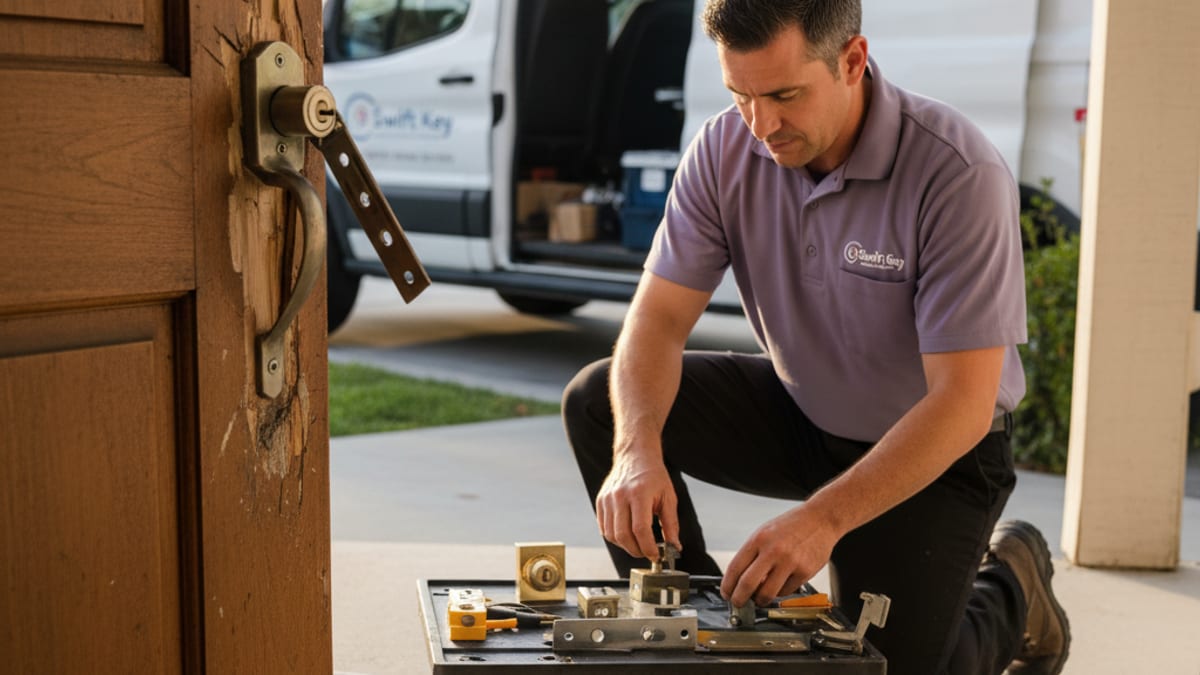
Now comes the locksmith call. Your first priority after the police clear the scene is to make the property secure enough to leave it overnight. We connect you with an emergency locksmith for exactly this kind of situation.
What a post-break-in locksmith visit covers:
- Rekey or replace any compromised locks. If the burglars used a key (either stolen from a hidden location or taken from a previous break-in), rekey all exterior locks. If they forced entry and damaged the lock, replace that lock and rekey the others.
- Repair or reinforce the door frame. A kicked-in door often splinters the frame around the strike plate. Temporary fix: reinforce with 3-inch screws and an over-sized strike plate. Permanent fix: replace the damaged section of frame, typically scheduled as a separate follow-up job.
- Board up or secure broken windows. Most locksmiths partner with a glazier or carry temporary window-board material on the truck. Otherwise you’ll need a separate glazier for the permanent glass repair.
- Install reinforced strike plates on intact doors. If they didn’t use the front door this time, they might try it next. Upgrading all exterior strike plates to 3-inch screws is a small add during the rekey call. Do it now while the locksmith is already there.
The goal tonight is sleepable security, well enough secured that you can lock up and go to bed without worrying. Full cosmetic repairs happen over the next week.
Hour 12-24: File the insurance claim
With the police report in hand and the photographs / inventory ready, call your homeowners or renters insurance. Every insurer has a specific claims line, don’t use the general customer service number.
When you call, they’ll assign a claim number and tell you how they handle an adjuster visit. Timing belongs to the carrier, not to a published window. The adjuster will walk through the property and document what you’ve already documented. Your photos and inventory give them a clearer file.
What to ask the claims line about:
- Damage to the property from the break-in (doors, windows, frames)
- Stolen property and any category sub-limits in your policy
- Additional living expenses if the property is uninhabitable
What to confirm in the policy itself:
- Whether emotional distress or time away from work is excluded
- Cash and jewelry sub-limits
- What documentation they want for high-value items
Save the locksmith receipt with the claim file. Reimbursement is a policy question. Read the policy and ask the claims line before assuming the bill is covered.
Days 2-7: The follow-up work
After the immediate crisis is handled, the longer-term work:
Get the permanent repairs done
Door frame repair, window glass replacement, any wall or molding damage, these get scheduled once you have the insurance claim number. Ask the claims line what emergency securing they will accept and what needs sign-off before structural work such as replacing a section of wall or reframing a window.
Review your home security
A break-in teaches you what’s weak. Common residential weak points in San Diego:
- Side gates and back fences, often overlooked because they sit out of view from the street
- Sliding glass doors, the factory latches are trivially bypassed; a metal rod in the track plus an auxiliary lock adds real security
- Dog doors, sized for a medium dog is also sized for a person; consider a dog door with an electronic collar sensor
- First-floor windows, cheap to break, often left unlocked; invest in window pins or alarm sensors
Consider upgrading to restricted-keyway locks
If the burglars may have duplicated your key (from a hidden spare, a stolen key, or an unknown prior copy), restricted-keyway locks (Medeco, Mul-T-Lock) prevent future unauthorized duplication. No hardware store or kiosk can legally duplicate a restricted key, only the authorized locksmith on file. Restricted cylinders cost more than standard hardware, but they provide audit-level key control.
Add smart cameras and alarms
If you didn’t have them, now is when to add cameras and / or an alarm system. A visible camera at the front door and at the back of the property can help you see who approached. Brands like Ring, Nest, and Eufy are common residential options. Check current hardware prices before you buy.
What not to do
A few things that commonly make the situation worse:
- Don’t clean up before the police arrive. It destroys evidence and photographs you’ll need later.
- Don’t post about it on social media right away. Burglars sometimes return to property where the owners are clearly out or occupied elsewhere. Wait a day or two.
- Don’t trust any “we were in the area and saw the damage” security pitch. Scammers target break-in victims specifically. Vet any service call (especially a locksmith) through their BSIS license before hiring.
- Don’t skip the rekey because “the lock still works.” If they had a key or could have copied one, the mechanical lock isn’t the problem, key control is. Rekey.
Frequently asked questions
How long does it take for a locksmith to arrive after a break-in in San Diego?
There’s no way to promise an exact arrival time. It depends on where you are in San Diego County and which independent locksmith accepts the job. Professionals work across the county, including more remote areas like Ramona and Fallbrook, not just the urban core. After the police clear the scene, call for a match. The locksmith sets their own start time.
Will homeowners insurance cover the locksmith bill after a burglary?
That depends on the policy. Save the itemized receipt and submit it with the claim. Ask the claims line whether emergency securing of the property is reimbursable and what deductible applies. Renters insurance is a separate contract. Read that policy too. Do not treat a receipt as a guaranteed payout.
Do I have to rekey even if nothing was taken?
Yes, if the burglars had any access to your keys or a hidden spare. Even if nothing was stolen, a standard key can be copied at a hardware store. Rekeying is quoted per cylinder by the locksmith. Ask them what they recommend after they inspect the remaining hardware.
How soon after a break-in should I replace the door frame?
As soon as possible for any split frame or kicked-in strike plate area. A door that closes and latches but has a cracked jamb or splintered frame is not secure, a firm shoulder can push it open. A locksmith can install an oversized strike plate with 3-inch screws as an immediate hardware option. Frame repair timing depends on the carpenter and on whatever your insurer actually requires. Ask the adjuster before you assume a window.
Can a burglar come back the same night?
It happens, though it’s not common. People who scoped a property sometimes return after the owners settle back in, assuming the new locks haven’t been installed yet. Securing the door after the break-in closes that window. Being visible at the property and having a working lock before you go to sleep is the priority.
Need an emergency rekey or door repair after a break-in in San Diego? Swift Key San Diego connects you with locksmiths who handle post-break-in security work. They rekey, repair damaged hardware, install reinforced strike plates, and can coordinate with your insurance on the receipt. Call (858) 400-4082 anywhere in San Diego County.