A cheap aftermarket remote on a Kearny Mesa counter does not mean the car in the driveway will accept it. Aftermarket key fob programming works only when the hardware matches that vehicle, the part number, and the functions the car actually supports. The matched locksmith or the dealer confirms compatibility and does the authorized work. Swift Key San Diego does not program fobs.
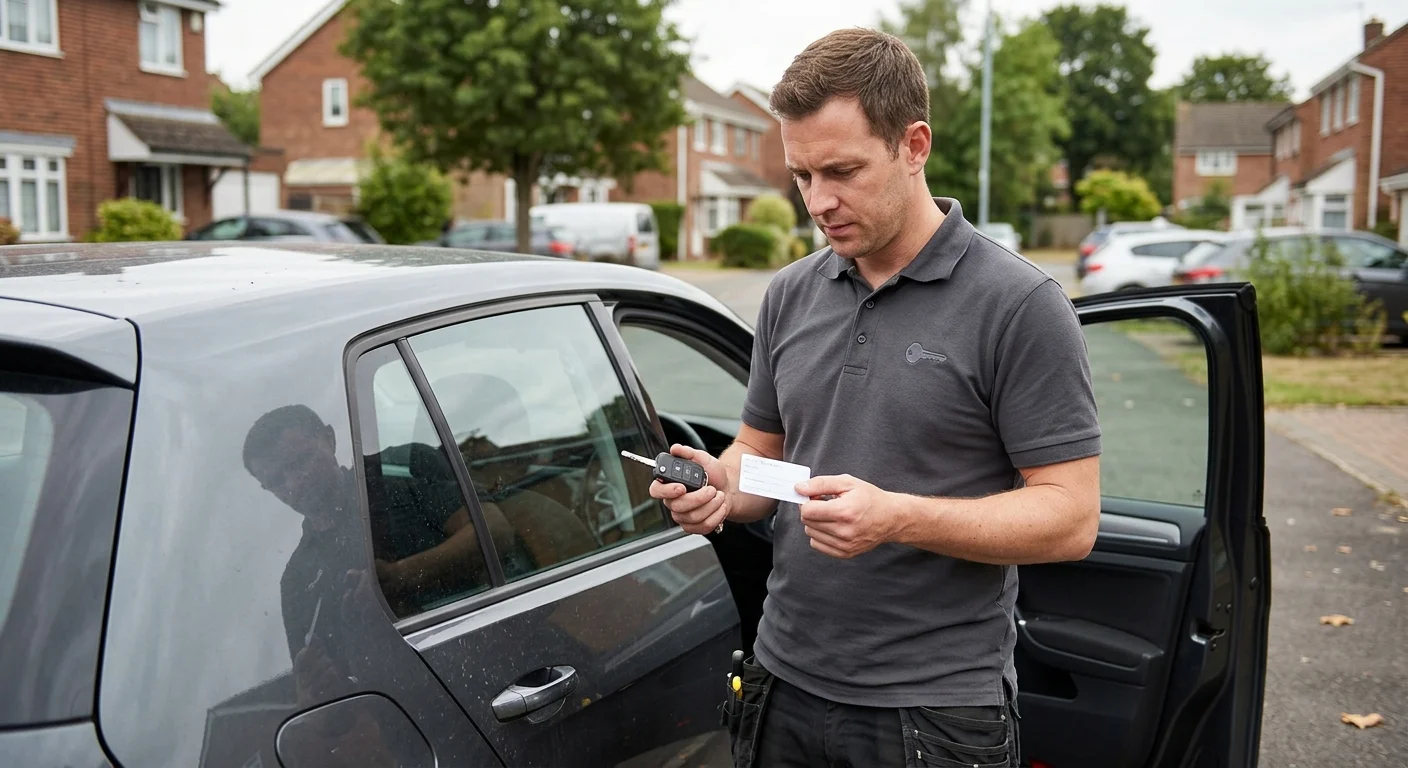
That is the whole decision. Identify the car and the remote first. Separate a new aftermarket fob from a used factory one. Confirm which buttons and start functions your trim actually has. Then compare what an independent locksmith can pair versus what the dealer will touch. Test every supported function in the parking lot before you approve the job.
Identify the vehicle, fob, and part number
Start with the car, not the listing photo. Write down year, make, model, and trim. A Honda Civic in Mira Mesa is not one car. An LX, an EX, and a Si can use different remotes, different blades, and different start systems. The same split shows up on Toyota Camrys in Chula Vista, Nissan Altimas along El Cajon Boulevard, and German cars around La Jolla and Rancho Santa Fe.
Read the VIN from the dash plate and the driver door jamb. That number is how a locksmith or a dealer looks up the exact key family. A marketplace title that says “fits 2015-2020 Honda” is not a lookup. It is a guess. Ask the seller for the OEM part number and the FCC ID printed inside the original fob. Then check those marks against current manufacturer documentation for your VIN. If the listing cannot give you those marks, do not buy it yet.
Look at the original remote if you still have one. Count the buttons. Note lock, unlock, trunk or hatch, panic, remote start, and sliding-door controls. Minivans in Poway, Santee, and East County school lots often have extra door buttons that a three-button aftermarket shell never had. A remote that looks close and still lacks a button will never grow that function after programming.
Ask one more question before you click buy: will the locksmith you plan to use work on customer-supplied hardware for this car? Some will. Some will only pair parts they source themselves. That is their call, not a county rule. If you also need a cut emergency blade, treat that as car key replacement work, not as a free extra hiding inside a remote listing.
Coastal cars add one local wrinkle. Salt air in Pacific Beach, Ocean Beach, Imperial Beach, and Coronado eats battery contacts and board traces. A fob that failed at a Mission Beach lot may need a new remote, not a new program. Inland heat in El Cajon, Alpine, and Ramona is harder on batteries. Bring the original fob, the aftermarket unit, and the vehicle ID to the conversation. Do not make the locksmith reverse-engineer a photo from your phone.
Separate aftermarket fobs from used OEM fobs
Aftermarket and used OEM are not the same spare. An aftermarket fob is new hardware that did not come from the automaker. A used OEM fob was built for that brand and already lived in another vehicle. Mixing those two is how San Diego drivers end up with a remote that unlocks nothing, or unlocks the doors and still will not start the car.
A used factory fob can carry old pairing data, a locked chip, or wear you cannot see. That path has its own checks. Read our guide on how to program a used key fob before you buy one off a parts car in National City or a swap-meet table in Spring Valley. Do not assume a locksmith can wipe every used OEM unit and make it behave like a new dealer remote. Some units can be added. Some cannot. The person doing the work has to say which, on your VIN.
Aftermarket units fail in a different way. The shell can match. The button layout can match. The FCC ID on the board can even match the original, and the car can still refuse the chip, the frequency, or the protocol. Matching marks raise the odds. They do not guarantee a pair. No honest listing can promise OEM range, OEM button feel, or OEM proximity behavior on every aftermarket remote.
Keep the two piles separate on the table. If you lost the only factory fob at a downtown garage or at the airport, you are not shopping for a used clone from a stranger’s Civic. You are deciding whether new aftermarket hardware is even accepted on that car, or whether the dealer path is the only one that will start it. If you still have a working factory remote, say so. Adding a spare is a different job than building a first key after every fob is gone.
California treats electronic programming of automotive keys and key fobs as locksmith work. That does not mean every remote on a shopping site is legal to pair, or that every shop will touch it. It means the person who programs electronic operating devices for pay needs to be operating as a locksmith under state law. Confirm the hardware type first. Then confirm who is allowed to pair it.
Confirm which functions the vehicle supports
Programming is not one button press. Your car may support door lock and unlock, trunk or hatch, panic, remote start, sliding doors, proximity unlock, and push-button start. It may support only some of those. The aftermarket fob may support even fewer. Write the vehicle’s list from the owner’s manual and from the original remote. Then write the aftermarket list from the seller’s documentation, not from the product photo.
A remote that locks the doors and never talks to the immobilizer is only doing half the job. Plenty of San Diego cars will unlock from the curb and still sit dead at the push button. That is a function mismatch, not a mystery. Door electronics and start authorization are separate conversations on many systems. If the listing only promises “keyless entry,” do not treat that as a start key.
Some older vehicles include an onboard learn procedure in the owner’s manual. The steps live in that book for that VIN. They do not live in a generic ignition-cycle post. If your manual has no onboard procedure, you do not have a DIY path. Many later models need diagnostic equipment and a person who knows that key family. A sequence copied from another brand can leave you with no working remote at all.
Parts-store programming is a separate question. A county-wide AutoZone (or any chain) policy on key fob programming could not be confirmed from our verified sources. Ask that store, on that day, what they will and will not touch. Do not treat a counter promise as a substitute for manufacturer documentation. If the job is electronic programming of a fob or transponder, California’s locksmith definition is the rule that matters.
If the original remote is flaky, fix the simple failures first. A dead battery, wet board, or corroded contact can look like a programming problem. Beach parking at La Jolla Shores, Mission Beach, and Imperial Beach soaks remotes. Cup holders on I-15 commutes cook them. Work through key fob troubleshooting before you buy a new aftermarket unit. Then confirm the replacement actually offers every function you need, including start.
Compare locksmith and dealer compatibility
A licensed locksmith can program a key fob on many vehicles. Not on every vehicle, and not with every aftermarket remote. California Business and Professions Code section 6980(j) defines locksmith work to include electronic programming of automotive keys and programming of electronic operating devices, including key fobs and door and ignition devices. That is the legal lane. It is not a promise that one mobile tech in Oceanside owns every tool for every Kia, BMW, or Toyota in the county.
That is also why the question can a locksmith program a car key fob has a conditional answer. Ask for the year, make, model, trim, and whether you still have a working key. Ask whether they will attempt aftermarket hardware or only OEM. Ask whether all-keys-lost is a different process than adding a spare. If they cannot name the system, keep calling.
Verify the company on the BSIS license search before anyone connects a programmer. Locksmiths in California are licensed by the Bureau of Security and Investigative Services, not by the contractors board. Ask to see the pocket license when the pro arrives. Swift Key San Diego is a referral service. We match you with licensed independent locksmiths. We do not hold a locksmith license, we do not perform the work, and we do not set the price. You contract and pay the professional directly.
Dealers still matter on some cars. A locked-down OEM process, a warranty that names dealer key work, or a brand the independent toolset does not cover can send you to Kearny Mesa, Mission Valley, or the South Bay dealer row. Dealers often want OEM hardware. That can be the right call. It is not automatically the only call. Get both answers in writing: will they pair this aftermarket unit, and which functions will they test.
Price is the question everyone asks, and a published dollar figure for aftermarket key fob programming in San Diego County could not be confirmed from our verified sources. Ignore round numbers you see on national blogs. Ask the locksmith or the dealer for the price on your VIN, your hardware, and this visit, before work starts. Key fob programming through a matched local pro is a compatibility job first. Cost follows the car, not a flyer.
Test every supported function before you approve
Do not nod at a dashboard light and walk away. Stand in the same lot where the car sits, whether that is a downtown garage, a Chula Vista driveway, or a beach lot off Mission Boulevard. Test lock. Test unlock. Test trunk or hatch. Test panic if the fob has it. Test sliding doors on a van. Test remote start if the vehicle and the fob both claim it. Then get in and start the car the way you actually start it, blade or push button.
Walk a short distance and try lock and unlock again. Aftermarket remotess are not guaranteed to match OEM range. If the listing promised driveway range and the fob dies at the sidewalk, that is a hardware limit, not a half-finished program. Say so before you approve. If doors work and the engine does not, stop. That is an incomplete job.
If you lost a fob, ask whether old remotes can be dropped from the approved list. Do not assume every aftermarket job can clear stolen or missing units. Some systems allow it. Some need a dealer session. Some need proof of ownership first. A locksmith who programs first and explains later is working in the wrong order.
Keep the original fob in your pocket during the test if you still have one. Confirm it still works after the new unit is added. Adding a spare should not kill the key you already trusted. If both remotes misbehave, you may be looking at a vehicle module issue, not the aftermarket board from a shopping site.
Approve the work only after the functions you were promised all work on that car. You pay the locksmith directly. Swift Key San Diego does not warranty the pair, because we did not perform it. The person who programmed the fob is the person who owes you a working lock, unlock, and start, on the functions that vehicle actually supports.
When to call us
Call when you have an aftermarket fob, a San Diego County vehicle, and no confirmed match on part number or functions. A licensed locksmith pro should verify compatibility, pair only what that car accepts, and test every supported button before you pay. Call us at (858) 400-4082 and we’ll connect you with a licensed local locksmith.