If a safe combination is forgotten, try four things in this order: the factory default code printed in the battery compartment or manual, the manufacturer’s combination-recovery service using proof of ownership, the override key if the model has one, and a locksmith who manipulates the lock open. Drilling is the last of the four, not the first.
A safe you can’t open is just a heavy box in the corner of your closet. Whether you’ve forgotten the combination on an inherited safe, the electronic keypad has faulted after years of service, or you’ve lost the override key to a modern keypad model, there’s almost always a non-destructive way to open it. A licensed safe technician starts with manipulation and only drills when necessary. Drilling is the last resort, and when it’s necessary, it’s done through a pre-documented entry point that can be repaired without compromising the safe’s fire and burglary rating.
Here’s what to try first, what your locksmith will try, and when you should just accept that the safe needs to be opened and the contents transferred to a new model.
Option 1: Check for the factory default combination
If the safe is new-ish or was given to you by a family member who never used it, the combination might still be the factory default. Manufacturers stamp or document default combinations in specific places:
- Sentry electronic safes: default is usually 1-2-3-4 or 0-0-0-0. Check the sticker inside the battery compartment for your specific model.
- Honeywell safes: default varies; check the documentation that came with the safe or search the model number online.
- Mid-tier electronic safes (Liberty HD, Cannon, SentrySafe): default override is sometimes on a sticker under the safe’s base or on the interior wall when open.
- Older mechanical dial safes: no default, these were set at the factory or by the original owner. If you have paperwork that came with the safe, the combination is often written on it.
Try the default first. Factory defaults on a sticker the owner did not know about solve a surprising share of forgotten-combination calls.
Option 2: Find the override key (for electronic safes)
Most modern electronic keypad safes ship with a physical override key, a small tubular or flat key intended for use when the keypad fails or the combination is forgotten. Check:
- Your desk or file cabinet drawers
- The envelope that came with the safe’s documentation
- Your safe-deposit box at the bank (ironic, but common)
- Your filing system with other important document keys
If you find it, insert it into the small hole in the center or side of the keypad, usually hidden under a decorative cap, and turn. The bolt retracts and the safe opens. Restore the keypad and either reprogram the combination or have it done by a locksmith.
Option 3: Fresh batteries (electronic safes only)
An electronic safe with a dead battery displays no keypad light and appears “broken”, but it’s actually just asleep. On most models you can restore power by:
- Finding the battery compartment (usually behind a small panel on the face, above or below the keypad, sometimes on the back of the door)
- Replacing with fresh alkaline batteries (usually 4x AA, sometimes 9V)
- Re-entering your combination
If you’ve never replaced the batteries in an old safe, start here. A cheap battery change solves a large share of “safe won’t open” calls.
Option 4: Manipulation (mechanical dial safes)
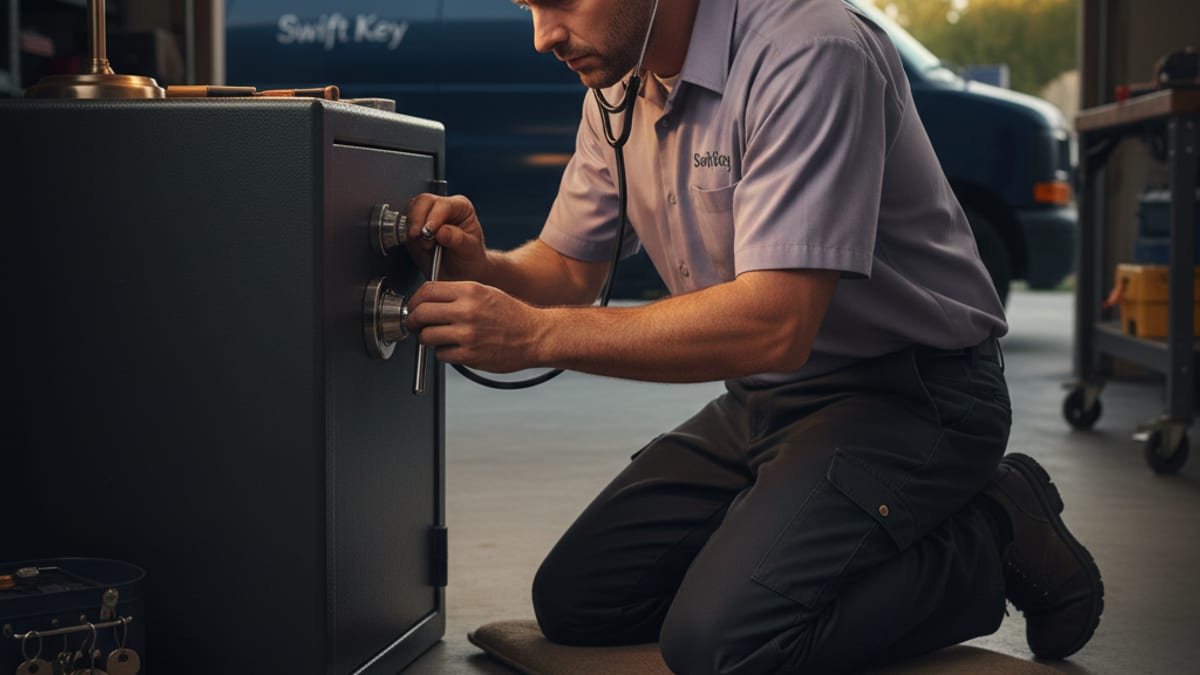
This is the classic “stethoscope-and-steady-hand” method you see in movies, and it actually works, on certain safes. A trained locksmith listens for the click or feels for the change in resistance as the dial’s tumblers align to the correct combination. How long the process takes depends on the safe’s lock design.
Which safes can be manipulated:
- Older dial safes (pre-1990) with standard 3-wheel or 4-wheel combination locks
- Many residential and commercial safes with Sargent & Greenleaf, LaGard, or similar standard mechanisms
- Safes without “manipulation-resistant” or “auto-relocker” features
Which safes can’t be manipulated:
- Modern high-security safes with spy-proof dials
- Safes with auto-relocking mechanisms that trigger when manipulation is detected
- Heavily worn or damaged locks where the tumbler clicks are unreliable
A locksmith who specializes in safe work can tell you fairly quickly whether your safe is a manipulation candidate. If yes, they quote manipulation and your contents come out clean.
Option 5: Contact the manufacturer
For safes less than 10-15 years old, the manufacturer may still have the factory combination on file. You’ll need:
- The safe’s serial number (usually on a metal plate inside the door when open, except, you can’t open it yet. It’s sometimes also on the back or bottom of the safe, or on the original purchase paperwork)
- Proof of ownership (receipt, inheritance paperwork, or an affidavit)
- ID matching the proof of ownership
Manufacturers like Sentry, First Alert, Honeywell, Liberty, and Cannon all have factory-combination recovery programs. The wait time is typically 2-4 weeks and they charge their own recovery fee. This is usually the cheapest option if you’re not in a hurry.
Option 6: Drilling (when non-destructive methods fail)
Drilling a safe isn’t like drilling a door lock, it’s a specialized, precise process. Safe technicians drill through pre-documented “drill points” that bypass the lock without damaging the safe’s hardplate (the steel armor protecting the bolt mechanism). The drill hole is usually 1/4” to 3/8” wide and is plugged with a hardplate insert after the safe is reopened, restoring the original fire and burglary rating.
What it costs in San Diego:
- Residential fire safes: opening plus hardplate repair as one total
- Liberty HD / Cannon / Winchester gun safes: heavier opening plus repair
- Commercial B-rate safes: heaviest opening plus repair
A reputable safe technician quotes the full open-plus-repair price up front, before drilling. If a technician drills first and then quotes the repair separately, that’s a red flag, always get the total in writing.
When to accept the loss and transfer
Some situations make drilling uneconomical:
- The safe is worth less than the repair cost. A cheap fire safe often isn’t worth a drill-plus-repair. Open it, transfer the contents to a new safe.
- The safe is already damaged. Old safes with pre-existing damage may not re-rate properly after drilling. Open, transfer, retire.
- The contents are low-value. If you’re opening a safe just to retrieve documents that exist in multiple places (digital copies, safe-deposit-box copies), sometimes the right call is to leave the safe closed and work from the copies.
How to handle an inherited safe
If you’ve inherited a safe from a relative and have no combination:
- Check all their paperwork first. Combinations are often written in address books, desk drawers, or bank safe-deposit envelopes. Spend an hour looking before hiring a professional.
- Contact the manufacturer with inheritance paperwork and the serial number. This is the cheapest legal path if you’re not in a rush.
- If the manufacturer can’t help, call a locksmith who specializes in safe work. Manipulation first, then drilling if necessary. Ask for an all-in residential quote, manipulation first, then drilling if needed.
- If the safe is a 1940s-or-older antique, manipulation is often successful because older mechanisms are predictable. Ask the technician whether they expect to drill.
Preventing this next time
For any safe you own:
- Write the combination in two places. One at your primary residence, one with a trusted family member or in a safe-deposit box. Not on a sticky note attached to the safe, that defeats the point.
- Keep the override key somewhere findable. If you have an electronic keypad with an override key, store it in a known, documented location.
- Change batteries every year. Mark it on the calendar. A cheap battery every year prevents a locksmith visit.
- Photograph the contents. If the safe is ever damaged or you need an insurance claim, knowing exactly what was inside matters.
Frequently asked questions
How long does a locksmith take to open a safe when the combination is forgotten?
It depends on the lock design and whether the safe has anti-manipulation features. Manipulation is the slower, more delicate method; drilling is quicker on the actual entry but adds a repair step afterward to restore the safe’s rating. A locksmith can usually tell you early on, after a look at the safe, which method applies to your situation.
What does it cost to have a locksmith open a safe in San Diego?
For a residential fire or document safe, ask for a non-destructive opening quote first. Drilling adds a hardplate repair line. Commercial and gun safes are heavier. A reputable technician gives you the open-plus-repair price before drilling. See our detailed safe opening cost guide for what to ask by safe type.
Can the manufacturer retrieve my forgotten safe combination?
Yes, for safes under about 10 to 15 years old. You’ll need the serial number (usually on the back or bottom of the safe, or on the original paperwork), proof of ownership, and a matching ID. Companies like Sentry, Liberty, and First Alert have combination recovery programs. The wait is typically 2 to 4 weeks plus the manufacturer’s recovery fee, so it’s the right path if you’re not in a hurry.
Will drilling ruin my safe permanently?
No, when it’s done professionally. A safe technician drills a precisely placed hole, usually 1/4 to 3/8 inch wide, through a documented drill point that bypasses the lock without touching the fire or burglary insulation. After the safe is open, the hole is plugged with a hardened steel pin and sealed, restoring the original security rating. It’s a surgical procedure, not a hack job.
What should I do if I inherited a safe with no combination?
Start by searching the deceased person’s paperwork: address books, filing cabinets, and safe-deposit envelopes are the most common places people store combinations. If that doesn’t work, contact the manufacturer with the serial number and inheritance documentation. If neither option pans out, call a locksmith who specializes in safe work. Ask for a residential inherited-safe quote, manipulation first and drilling if necessary.
Need a safe opened in San Diego? Swift Key San Diego is a referral service. It does not open safes. Call (858) 400-4082 to connect with a licensed independent locksmith. That locksmith quotes after they inspect the safe. You pay them.