The alley gate in North Park still takes a padlock, and you want a code instead of a key. A keyless entry smart lock can work on some exterior gates, but only when the gate, the latch, and the model all match. That is a different job from a front-door retrofit.
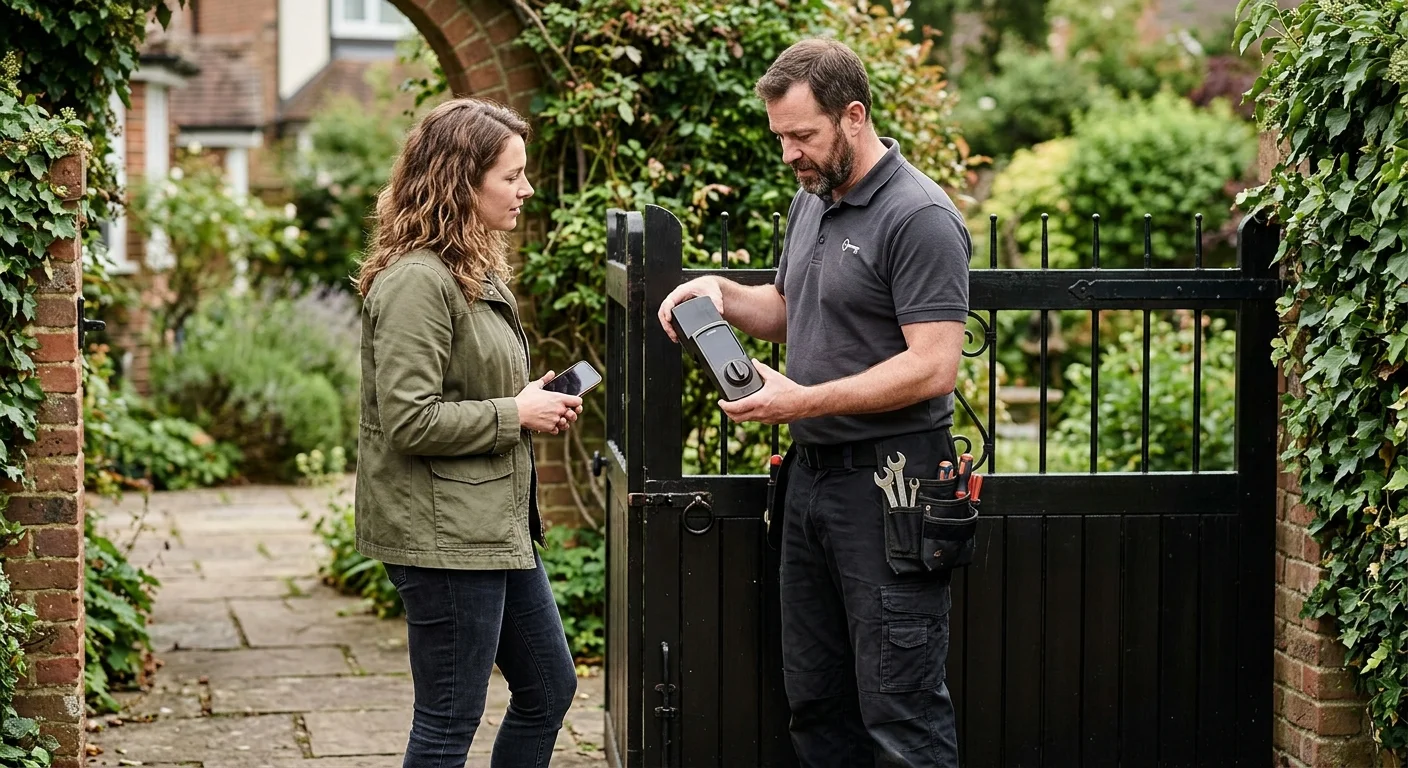
Identify the gate, latch, and existing preparation
Start with the opening, not the app. San Diego yards use a few common gate types, and each one holds a lock in a different way.
A pedestrian side gate is the usual candidate. It swings like a door and meets a strike on the post. Driveway gates are another class of hardware. Many of them roll, slide, or run on a vehicle operator. A door-style smart lock is not a substitute for that operator. If the leaf is a rolling carriage, this product class does not apply.
Name the latch you already have. A gravity latch and a padlock hasp are not a deadbolt prep. A rim latch on a wood gate is not a bored cylindrical lock. Tubular steel and other metal leaves often use a surface box or a weld-on case. Vinyl gates in East County tracts sometimes hide a thin latch in a hollow stile. None of those start as a typical front-door bore.
Look at the stile, the vertical member that would carry the lock. A front door is thick and wide enough for a bored lockset. A gate stile can be narrow, hollow, or round. If there is no flat face, no backset, and no strike that lines up, you do not have a smart-lock prep. You have a gate that still needs mechanical work.
Note how the gate hangs. Coastal iron in Imperial Beach and Coronado often sags after years of salt and weight. Inland wood in El Cajon and Ramona can swell in heat, then shrink. If the latch already misses the strike, a motorized bolt will miss it too. Alignment is the first repair. Electronics will not straighten a leaning post.
The city of San Diego has a large share of older housing. About 49.6% of homes in the city were built before 1978. Side gates on those lots often mix hardware from several decades. Photograph both faces, the strike, and the gap at the latch. That record is what a licensed locksmith reads before anyone orders a keypad lock for an outdoor gate.
HOA and rental rules can block a change. A shared pedestrian gate at a Mission Valley or Pacific Beach complex often sits on a building system, not a single house lock. Confirm who owns the gate before you plan a private code.
Check fit before comparing smart features
Shoppers looking up a keyless entry smart lock see door roundups first. Those pages rank models by app, keypad, and brand. That order is backwards for a gate.
Fit comes first. Smart features come second. A lock that will not sit in the stile cannot use Wi-Fi, a fingerprint reader, or a guest code. Smart gate lock compatibility is a hardware question, not a software one.
Most consumer smart locks are built as deadbolt replacements or as interior adapters for a door. A retrofit adapter that sits on the inside of a front door has nowhere to sit on a see-through iron gate. A full replacement deadbolt still needs a door thickness and a bored hole that the maker publishes. If your gate has neither, that model is not a candidate, no matter how the reviews read.
Kwikset, Yale, and Schlage pages you will see in search describe door hardware. A smart lock for exterior gate use has to live on a fence, not a porch. Read the current installation template from the maker, not a retailer blurb. Confirm thickness range, backset, hole size, and handing. Then measure the gate. If the stile is thinner, narrower, or rounder than the template, you need a different product family or a different mechanical prep. Some outdoor gate locks are surface-mount. Some sit in a weld-on box. Some are built as a latch, not a deadbolt. Those are not interchangeable.
Handing and swing matter. A gate that opens out toward an alley in Hillcrest presents the exterior face to the street. A gate that opens into a courtyard in La Jolla does the opposite. The keypad has to face the person standing outside. The interior module, if the design has one, needs a protected side. On an open iron gate there may be no protected side.
Clearance is easy to miss. A thick keypad can hit the post when the gate closes. A motorized bolt can miss a shallow strike. A handle-style unit can snag on a close-set post in a tight South Park side yard. Door locks are often sold with an ANSI/BHMA grade. Confirm whether that grade even applies to the gate product in your hand.
If you already compared smart lock fit on an existing front door, reuse that habit, not that hardware. The checks are a useful list. The measurements will not transfer. A door and a gate share a swing. They rarely share a prep. Do not pick a “top rated” door lock and assume the gate will take it. Roundups test doors.
Review power and connection needs by model
A keyless entry smart lock is an electronic device on a moving leaf. It needs power. It may need a radio path back to the house. The backyard is a harder place for both than a front door on the street.
Open the current spec sheet for the exact model. Note the power method. Many door models run on batteries inside the interior housing. Some outdoor products are designed around low-voltage wiring. Some include a keyed cylinder as a backup when the electronics sit idle. None of those details are universal. If the sheet does not list a power method for outdoor use, treat that model as unverified for a gate.
Battery packs live in weather. A side gate in Point Loma or Ocean Beach sees salt air and fog. A rear gate in Escondido or Santee sees heat on a west-facing fence. Heat and moisture both shorten battery life. I will not quote a month count, because that figure is model-specific and the maker can change it. Plan on checking the published low-battery warning and replacing cells on the maker’s schedule, not on a guess.
Connection type changes what the lock can actually do. Bluetooth-only control works when your phone is near the gate. That is fine for a side yard you walk every day. It is a poor match if you want to let a dog walker in from downtown. Wi-Fi control needs a usable signal at the gate, not at the living-room router. Other radios usually need a hub inside the house. A long lot in Rancho Bernardo or a stucco wall in Clairemont can block that path. Walk the gate with your phone and see what the network actually shows. A bar in the kitchen is not a measurement at the fence.
Remote unlock, activity logs, and shared codes are useful when the radio path is real. They are marketing when the gate sits behind two buildings and a block wall. If the model needs a 2.4 GHz network, confirm that band reaches the opening. If it needs a module for remote access, confirm the module is listed for that model and that the enclosure still meets the outdoor notes on the sheet.
Power and radio limits are two of the real downsides of smart locks on a gate. A dead battery at the back fence is a lockout with no neighbor to hear you. A dropped connection means the app will not help. A keypad-only outdoor lock avoids some of that, and it also drops remote features. Choose the trade on purpose.
Confirm the manufacturer’s exposure limits
San Diego is not one climate. A keypad lock for an outdoor gate in Imperial Beach is not the same exposure as one in Alpine.
Coastal neighborhoods take salt. Pacific Beach, La Jolla, Coronado, and the South Bay get marine air, fog, and irrigation overspray. Inland valleys take heat and dust. That difference shows up on metal finishes and on electronics. We already cover smart lock corrosion along the coast and gate lock corrosion in Imperial Beach. A gate lock lives closer to soil, sprinklers, and fence paint than a front-door deadbolt does.
Do not trust a product photo of a patio. Open the maker’s outdoor and temperature notes for the exact SKU. Look for the published exposure rating, indoor-only language, and any ban on direct rain or hose spray. If the sheet says indoor, or lists a door, or is silent on outdoor use, that model is not confirmed for an exterior gate. Silence is not approval.
This page will not invent an outdoor rating, a year of service, or a weatherproof promise. Those figures change by generation, and they belong to the manufacturer. If you cannot find a current outdoor note, pick a different model or ask the locksmith to show you the sheet on site.
Finish and fastener material matter as much as the circuit board. Painted steel on a coastal gate can bloom rust around a new stainless screw. Dissimilar metals in salt air corrode at the joint. A vinyl gate can flex and crack around a heavy keypad. A wood gate can cup until the bolt drags. None of that is a software setting.
Sun angle is a local issue. A west-facing alley gate in North Park bakes in the afternoon. Touchscreens can wash out. Plastics can chalk. If the model uses a touchscreen, read whether the maker rates it for direct sun. Physical buttons often fare better with wet fingers after a June gloom morning, but that is still a model-by-model check, not a rule.
Water does not only fall as rain. Sprinkler heads along a Mission Hills parkway, hose bibs in a Golden Hill yard, and standing water at the bottom of a metal gate all reach a lock from below. Mounting height and drip edges are part of the exposure review. If the lowest seam of the housing sits in the splash zone, the sheet’s outdoor claim may not describe your install.
When an independent locksmith should inspect it
Stop DIY when the gate needs metalwork, a new prep, or a lock that the maker sells as a professional install. California treats lock installation as locksmith work. Locksmiths here are licensed by the Bureau of Security and Investigative Services, not by the contractor board. You can verify a company or employee before anyone drills a stile.
California Business and Professions Code section 6980(j) defines a locksmith as a person who, for compensation, rekeys, installs, repairs, opens, or modifies locks, or originates keys. Installing a keyless entry smart lock on a gate sits inside that definition. Swift Key San Diego is a referral service. We do not hold a locksmith license, we do not send our own trucks, and we do not perform the work. The independent locksmith you are matched with does.
Call for an inspection when any of this is true. The stile has no published prep for the model you want. The gate sags or binds. The strike is on a round post. You need a weld-on box or a new latch. The opening is a shared property gate. You want authorized smart lock installation rather than a best-effort retrofit. You may also need lock replacement if the existing latch is worn, corroded, or the wrong function for a motorized bolt.
Ask the locksmith to bring the current template and the outdoor notes, not a generic kit. Have them confirm handing, clearance, power, and radio path on site. If the model is a poor fit, a different mechanical lock with a simple keypad can still give you keyless entry without forcing a door deadbolt onto a fence.
Security limits belong in that visit too. A smart lock is not unhackable. Shared codes linger after a housekeeper or tenant leaves. Weak PINs are easy to watch on a street-facing gate. An old firmware build is the maker’s problem to patch, and only if you actually install updates. A keyed backup, where the model includes one, is a practical fail-safe when the electronics sit dead. None of that is a reason to skip the lock. It is a reason to treat codes like keys and to hire someone who will set the hardware so the bolt actually throws.
Bring ID that shows you control the property. A licensed locksmith has to confirm they are opening or altering the right gate.
When to call us
If the gate needs a real prep, a rated outdoor model, or an authorized install, talk to a licensed locksmith before you order hardware. Call us at (858) 400-4082 and we’ll connect you with a licensed local locksmith.