If your Yale lock battery is dead and you have no key, you are locked out until that lock has power again or a licensed locksmith opens the door. The keypad stays dark. A code will not land. Many Yale smart locks sold in San Diego County are key-free, so there is no cylinder under the keypad to fall back on.
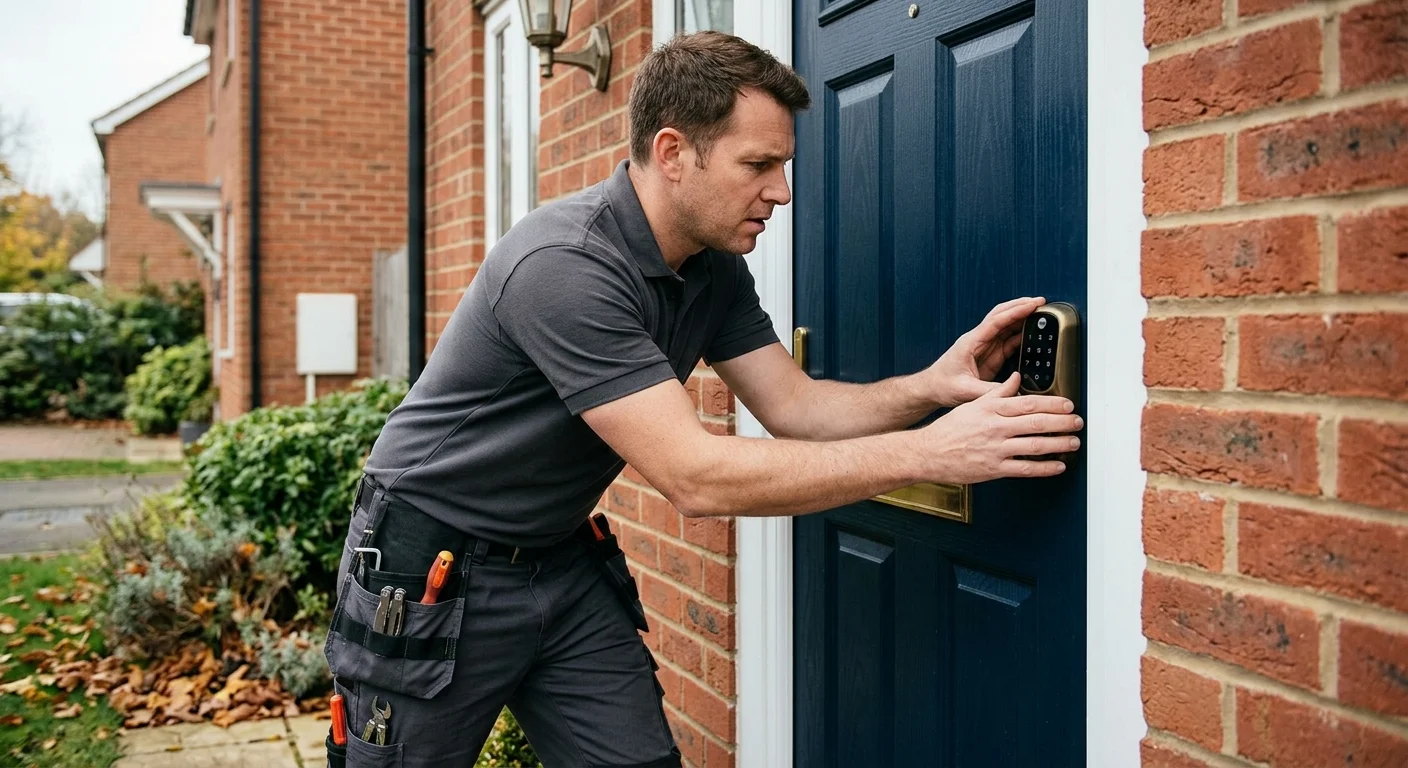
Confirm the Yale model and remaining access methods
Start with the model. Yale keyed and key-free versions look similar from the porch. An Assure Lock 2 with a cylinder is a different lockout than a Nest x Yale with no keyway. The wrong backup path wastes time and can scar the finish.
If someone is still inside, the interior battery cover is the cleanest ID. The model line is usually printed on the housing, on a label behind the cover, or in the Yale Access / Yale Home app under the lock’s device details. From outside, look for a mechanical keyway below or beside the keypad. A smooth plate with no keyhole is a strong sign you are on a key-free version. A Wi-Fi module on the interior will not help from the sidewalk if the pack is already dead.
Write down what you still have. A person inside can turn the thumbturn and swap cells. A working access code only helps after the lock has power. A mechanical key only helps if this version was built with a cylinder and that key is reachable. Phone-app unlock needs enough battery for the radio. On a fully dead pack, the app is usually silent.
San Diego County is not one climate for these locks. West-facing doors in Pacific Beach, Ocean Beach, and Imperial Beach take salt film on the keypad. Afternoon glare on those west entries can make a live keypad look dead. Check the buttons from the side, out of the sun, before you call the pack empty. Inland doors in El Cajon, Escondido, and Ramona cook interior cells in summer heat. Same Yale family, different failure. Older stock in the city of San Diego makes the door itself part of the problem. About 49.6% of homes in the city of San Diego were built before 1978, and retrofit smart locks on those slabs often sit on doors that have already sagged.
If you cannot name the model from the porch, open Yale’s current support site, match the photo to your keypad housing, and download that model’s PDF. Follow only the access methods that PDF lists. For a generic dead-pack lockout on any brand, see our guide to a smart lock battery that died while you were locked out. If you are already standing in a home lockout with no spare, that is the service path.
Check only the backup power steps Yale documents
Yale documents a temporary 9-volt wake-up on some keypad models. The usual published shape is two metal contacts on the bottom of the exterior keypad. You hold a 9-volt battery against those contacts so the lock can take a working code for a moment. That is a manufacturer backup-power step. It is not confirmed for every current Yale lock.
This page could not pull a live, model-by-model Yale PDF for every lock sold in San Diego County. Treat that gap as a stop. If your model’s current manual does not show 9-volt contacts, the 9-volt path is not confirmed for your lock. If the underside of the keypad is a smooth plastic lip with no metal pads, leave it alone. Stay outside the housing. Skip drills, jumpers, and seam tools. Those are not Yale backup-power steps.
If the manual does show contacts, follow that PDF’s polarity and hold. Use a known-good 9-volt. Coastal corrosion along Mission Beach, Coronado, and Imperial Beach can film those pads so a good battery still does nothing. Wipe only what the manual allows you to reach. If the lock wakes, enter a code you already know. Leave factory reset alone on a lock you cannot prove you own. Yale’s reset paths are model-specific. If the PDF does not list a reset you can do from the exterior with a dead pack, that reset is not confirmed.
A Yale Assure Lock 2 dead battery on a keyed version still needs power for the motor even if a key exists. The key is a mechanical override. It is not a charger. A yale smart lock dead battery on a key-free version has only the documented jump, an inside helper, or a locksmith. If you are inside the house, skip the 9-volt step. Open the interior cover and replace the cells with the type and count printed in the manual. Keep the set matched. Put the cover back until it latches. Test the code and the thumbturn before you close the door.
A keypad that stays dark can also be a cable, a packed-up board, or sun-faded buttons. Work through the dark-keypad checks in Yale keypad not lighting up after you have ruled out a dead pack. If backup power never wakes the lock, you are past DIY.
Separate a dead battery from a failed lock
A dead pack and a failed lock can look identical from the porch. They are different jobs. A dead battery is dark and silent. No LED. No tone. The app shows the device offline. A brief 9-volt wake, if your manual documents one, brings the keypad back long enough to accept a code. After fresh cells, the lock behaves.
A failed lock still has some life and still misbehaves. The keypad lights and rejects a code you know. The motor whirrs and the bolt never moves. The bolt moves and misses the strike. You get an error chime the manual never made obvious. Fresh cells do not clear it. That sits with Yale Assure lock problems more than with a simple pack swap.
Local weather splits the two. Salt air on coastal north county doors in Encinitas, Carlsbad, and Solana Beach eats the keypad membrane and the 9-volt pads. You can hold a new 9-volt on filmed contacts and still get nothing. Heat inland is harsher on the cells themselves. A pack that died in a west-facing El Cajon entry in August is often just exhausted chemistry. The same lock in a shaded North Park courtyard may be a sagging door. Pre-1978 slabs in City Heights, South Park, and parts of Chula Vista rack the strike. The motor runs. The bolt hits wood. The lock looks dead. It is out of line.
Stop feeding codes into a lock that already woke. You can lock the keypad or drain the last of a jump. Keep lubricant out of the keypad. Leave the bolt alone from the gap. If the 9-volt wake works once and never again, the interior pack is empty and you still cannot reach it from outside. If the wake never works and the keypad never lights, treat it as a lockout. The next useful step is a licensed locksmith at the door.
When the mechanical key still matters
Yale does not put a physical key on every lock. Keyed versions have a cylinder. Key-free versions do not. Nest x Yale was sold as a key-free lock. Assure Lock 2 ships in keyed and key-free versions that share a similar keypad face. If you never received a key at install, you may own a lock that has no keyway.
The mechanical key still matters when this lock was built with a cylinder and that key is reachable. Check the car, a drawer, a neighbor, a property manager, or a former roommate before you assume it is gone. A spare in a garage lockbox only helps if you can open the garage. Leave the cylinder unpicked. Originating a key, opening the lock, or servicing the cylinder is locksmith work under California Business and Professions Code section 6980(j). In this state that work requires a BSIS license.
A yale lock with no key and a dead battery stacks both failures. The keypad has no power. The cylinder is unused, lost, or was never there. Short-term units around Pacific Beach, Mission Beach, and downtown often go key-free so guests never hold a metal key. Hosts then find the pack died while the unit sat empty. Rentals in older South Bay houses sometimes mix a Yale keypad on a door that still has a separate deadbolt. Check every cylinder on that door before you decide there is no key at all.
If the only key is inside the house, the keyway on the porch cannot reach it. Skip fishing under the door. Skip the mailbox hunt. If backup power fails and no key is in your hand, the lock needs a licensed pro.
What an independent locksmith should inspect
Swift Key San Diego is a referral service. We match you with licensed, independent locksmiths. We hold no locksmith license, own no trucks, and do no installs. The locksmith we connect you with inspects the door and performs the authorized work. You contract with that pro, and you pay that pro.
Ask them to confirm the model and whether the version is keyed or key-free before work starts. A dead pack on a working motor is a battery and alignment check. A dark keypad with filmed contacts on a beach house is often corrosion. A motor that runs into a missed strike on a pre-1978 San Diego city door is carpentry as much as electronics. Once the door is open, the locksmith should look at the interior pack, replace cells only to the spec in Yale’s manual, and test the code, the thumbturn, and the auto-lock setting before leaving.
They should also confirm you belong at the door. Bring ID. California locksmiths are licensed by the Bureau of Security and Investigative Services, not the contractors board. You can verify a company or employee at the DCA license search. Ask to see the pocket license when they arrive.
If the hardware is finished, a matched pro can talk through replacement and a cleaner install path. That is smart lock installation work. On older East County doors in Lakeside or Santee, a Grade-rated deadbolt with a key you actually hold may be the saner backup than another key-free keypad. On coastal entries, ask about finish and gasket condition. Salt will film the next pack’s contacts if the housing is already chalking.
A drill should be a last resort the locksmith explains before they start, and only after documented backup power and a reachable interior are off the table. We do not set that method. The independent locksmith does.
When to call us
Call when the keypad stays dark, Yale’s documented backup power does not wake your model, and you have no spare key in hand. A matched local locksmith can open the door, inspect the pack, and repair or replace the hardware you actually have. Call us at (858) 400-4082 and we’ll connect you with a licensed local locksmith.