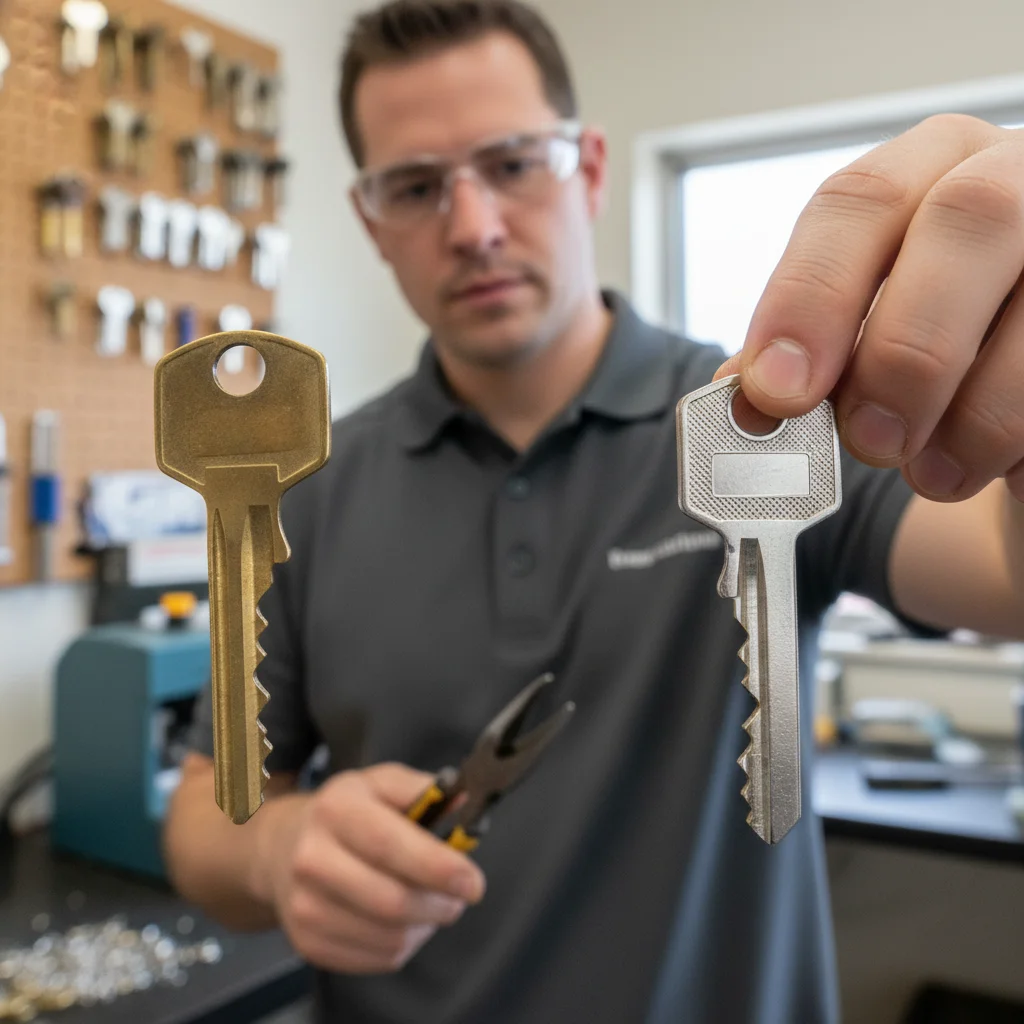
A hardware store or kiosk can be enough for a common, unworn house key when the store stocks the blank. Worn keys, uncommon blanks, electronic car keys, restricted keyways, and no-key origination need the store or locksmith to confirm they can actually do the job. Neither option is automatically “more accurate for every key.”
Swift Key San Diego is a referral service. Independent licensed locksmiths cut keys they support, confirm authorization, and set their own prices. Swift Key does not cut keys.
How key cutting machines differ
Many store machines are duplicators. A stylus traces the original while a cutter grinds a blank to match. If the original is close to its intended shape and the machine is in good condition, that copy can work.
Locksmiths may also trace a key. Some can code-cut: they cut to a known bitting for that lock or key, instead of copying wear. Code cutting is useful when the original is worn, if the locksmith can read the key or the lock. It is not available for every keyway, and it is not a promise that every worn key can be restored.
Tracing an imperfect original can produce an imperfect copy. That is why a second copy of a failed kiosk key often works worse, not better.
Why copies of copies fail
House keys wear. Brass rounds off. Each traced generation can drift farther from the pin heights the lock needs. A few thousandths of an inch of error can make a key grind or refuse to turn.
Typical sequence:
- Daily use wears the original.
- A duplicator traces the worn shape.
- The new key may work, or it may feel gritty.
- Copying that copy adds another layer of error.
If a kiosk copy already failed, stop tracing it. Have the lock or the original key inspected.
When a hardware store copy is a reasonable first try
A store or kiosk may fit when:
- The original is a common residential key in good condition.
- The lock is a low-stakes padlock or interior door where a slightly imperfect copy is acceptable.
- The store stocks the marked keyway.
It is a weaker fit when:
- The original is the only key and it already binds.
- The key is a car key that may need programming.
- The key looks restricted, patented, or is marked for controlled copying.
- You have no key and need origination from the lock.
For those cases, ask a locksmith or the system’s authorized source to confirm options. See key duplication.
Restricted keys and “Do Not Duplicate”
A “Do Not Duplicate” stamp is a policy marking. This site does not treat it as a settled California legal command, and it does not treat the stamp as empty. Ask the owner, manager, or key issuer before copying.
A restricted or high-security keyway is different. Blanks and cutting rights often run through an authorized dealer. A hardware store may not stock the blank. A locksmith who is not on that system may not be able to cut it either. Authorization belongs to the property controller, not to Swift Key.
Frequently asked questions
Why does a hardware store key copy sometimes not work?
Duplicators trace the original. Wear, a wrong blank, or a poorly calibrated machine can produce a key that sticks or will not turn.
What is code cutting and why does it matter?
Code cutting uses the lock’s or key’s intended bitting rather than tracing a worn blade. When a locksmith can decode the key or cylinder, the new key can match the factory depths more closely than a trace. Not every key can be decoded that way.
Can a locksmith make a copy from a worn key?
Sometimes. They may measure the key, read the lock, or tell you the cylinder is too worn and should be rekeyed or replaced. Ask them to inspect it. There is no universal result.
How much does professional key duplication cost compared to a kiosk?
Stores, kiosks, and locksmiths set their own prices. Ask each provider for the blank type and the cutting method. Swift Key does not set duplication fees.
When is a hardware store copy good enough?
When you have a common, working original and a simple lock. For worn, electronic, restricted, or no-key situations, get a locksmith or dealer assessment instead of assuming the kiosk will work.
When to call
Call (858) 400-4082 for a referral when:
- The only remaining key is worn, bent, or already failing in the lock.
- You need a car key assessed for cutting and programming.
- A kiosk copy failed.
- The key may be restricted and you have the owner’s authorization to request a copy.
The matched locksmith confirms what they can cut and quotes the work. They do not guarantee that every key copies on the first attempt.